A-DSLT is a theoretical and operational framework used to prevent communication mismatches and breakdowns at workplaces.
Neurodiverse people learn and communicate differently than neurotypical people. This challenge can be harmonised when designing organisational communication systems. It benefits all neurotypes.
Communication is central to social coordination, learning, and professional activity. Within organisational contexts, successful communication is commonly assumed to depend on shared norms, implicit understanding, and mutual interpretation of contextually embedded cues. These assumptions are rarely made explicit; instead, they are treated as natural, universal, and self-evident. However, growing scholarship in autism research, neurodiversity studies, and organisational communication suggests that such assumptions may obscure systematic differences in how individuals acquire, interpret, and apply social information.
Autistic individuals, in particular, are frequently reported to experience persistent communication difficulties in professional environments. These difficulties are often framed in terms of deficits in social skills, pragmatic language, or theory of mind, leading to interventions focused on individual remediation. Yet empirical findings increasingly challenge unilateral deficit-based explanations. Studies demonstrate that misunderstandings between autistic and non-autistic individuals are often reciprocal, context-dependent, and strongly shaped by environmental expectations rather than by individual impairment alone.
At the same time, contemporary workplaces continue to rely heavily on implicit communicative norms, including indirect instruction, unspoken expectations, tone-based evaluation, and informal rule transmission. Such environments may function effectively for individuals whose social learning histories align with these norms, while systematically disadvantaging those whose learning trajectories emphasise explicit instruction, rule clarity, and consistency. Despite the growing recognition of neurodiversity as a form of human variation, limited theoretical attention has been devoted to how differences in social learning trajectories interact with organisational communication systems to produce predictable patterns of misalignment.
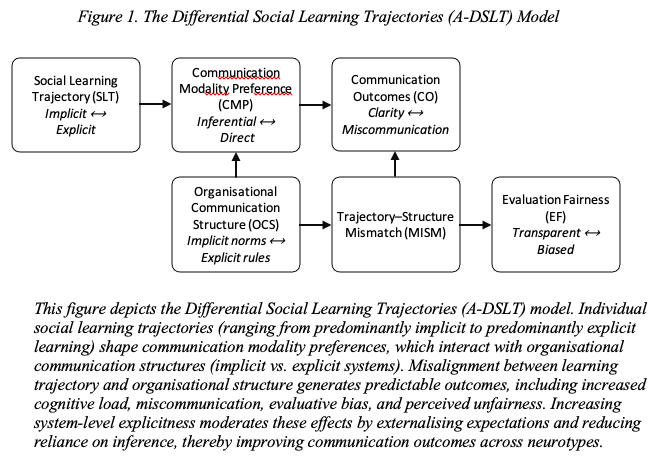
Divergent ways of communicating leads to misunderstandings and expectation mismatches, especially because organisations tend to favour the implicit modality.
By changing essential organisational systems towards explicit modality, which in fact benefits all types, one can expect less issues and more fair evaluations of performance. A-DSLT based reengineering changes systems, not people, and does not require disclosure of employee neurotype.
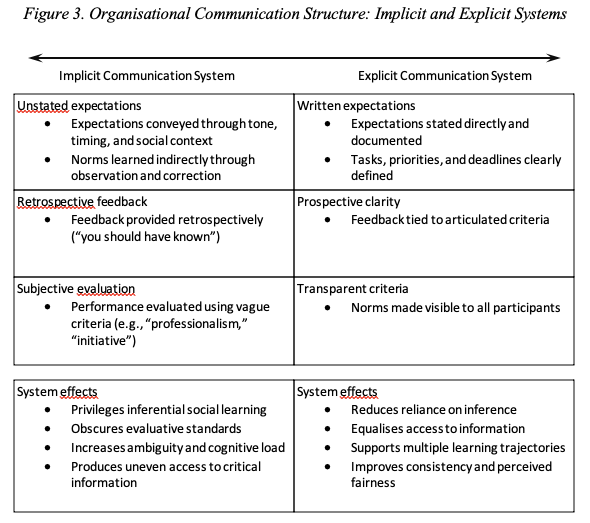
Existing frameworks do not fully integrate developmental social learning mechanisms, organisational communication design, and systems responsibility. Deficit models overlook reciprocity, interactional models lack mechanistic specificity, and organisational theories rarely incorporate neuro-developmental variation.
The A-DSLT model addresses this gap by proposing that autistic and non-autistic individuals often follow different social learning trajectories – explicit and implicit respectively – and that organisational communication systems are typically structured around implicit learning assumptions. When these systems fail to externalise expectations, predictable breakdowns occur. By integrating developmental learning theory with organisational design, A-DSLT offers a testable, systems-level explanatory framework.
A-DSLT offers a generative research agenda and a blueprint for institutional change, with the potential to reshape clinical, educational, and workplace approaches to autism in ways aligned with respect, accessibility, and justice.
Read the thesis paper at ResearchGate, https://doi.org/10.13140/RG.2.2.36179.44327
The Explicit.Systems Consulting site has resources and tools for use in organisational change based on the A-DSLT framework.
Send Me a Message


Copyright 2025-2026 Bjorn Ivesdal
Thesis Abstract (for Search Engines)
Autistic communication has long been described in clinical, educational, and social science literatures through a deficit-based lens emphasising impairments in social inference, pragmatic language, and mental-state reasoning. These perspectives have shaped diagnostic criteria, informed therapeutic interventions, and influenced public attitudes toward autism.Yet a growing body of empirical evidence contradicts the universality of these claims. Autistic–autistic interactions are often fluent, coherent, and high in mutual comprehension; laboratory studies reveal that autistic individuals perform comparably to or better than non-autistic peers on structured, explicit social tasks; and cross-neurotype miscommunication often arises not from autistic cognitive failure but from divergent communicative expectations and mismatched assumptions. This body of evidence demands an updated theoretical account capable of explaining both the unique strengths of autistic communication and the difficulties that arise in cross-neurotype contexts.The Autism-Specific Differential Social Learning Trajectories (A-DSLT) model developed in this dissertation addresses this theoretical gap. A-DSLT proposes that autistic and non-autistic social communication differences emerge from fundamentally different dominant learning pathways. Non-autistic individuals rely heavily on implicit learning mechanisms that absorb social norms through early, unstructured exposure. Autistic individuals, by contrast, rely more heavily on explicit, analytic learning mechanisms, acquiring social knowledge through deliberate reasoning, explanation, and conscious attention to structure. These divergent developmental pathways shape the internalisation, representation, and application of social rules, which in turn create distinct communication modalities: implicit, inferential, and subtextual for non-autistic individuals, and explicit, precise, and low-ambiguity for autistic individuals.A-DSLT reframes autistic communication differences not as deficits but as logical products of explicit developmental learning. This model accounts for observed patterns such asdelayed – but more exact – social rule acquisition in autistic individuals; strong autistic performance in explicit, structured contexts; and communication fluency among autistic peers. It further provides a mechanistic explanation for the Double Empathy Problem – are search framework demonstrating that autistic and non-autistic individuals frequently misunderstand one another not because of autistic social impairment but because of mismatched communication norms. A-DSLT identifies modality mismatch as the downstream result of divergent learning histories and positions miscommunication as relational rather than intrapersonal. This dissertation elaborates the full theoretical architecture of A-DSLT, evaluates its testability, and articulates its implications for research, intervention, and policy. A comprehensive empirical plan is provided, including structural equation modeling, multi-group comparison across neurotypes, dyadic interaction paradigms, and cross-contextual–experimental designs. The dissertation further advances a large-scale applied framework for neurodiversity-affirming practice, with special focus on workplace environments where implicit, unspoken rules are ubiquitously privileged. The A-DSLT model demonstrates that modifying institutional structures, rather than seeking to normalise autistic behavior, is the most effective pathway to reduce miscommunication and promote equity.
Page 3
THE AUTISM-SPECIFIC DIFFERENTIAL SOCIAL LEARNING TRAJECTORIES MODELThesis Proposal, B. Ivesdal, Geneva (CH), 26 December 2025 3The model’s contribution is theoretical, empirical, and applied. It provides a non-pathologising mechanistic foundation for autism research, integrates developmental learningscience with interactional theories of communication, supports neurodiversity-alignedpractice, and extends the emerging scientific understanding that autistic communication is not“deficient” but differently organised. A-DSLT offers a generative research agenda and ablueprint for institutional change, with the potential to reshape clinical, educational, andworkplace approaches to autism in ways aligned with respect, accessibility, and justice.
THE AUTISM-SPECIFIC DIFFERENTIAL SOCIAL LEARNING TRAJECTORIES MODEL (A-DSLT): DEVELOPMENTAL MECHANISMS, COMMUNICATION DYNAMICS, AND SYSTEMIC IMPLICATIONS IN ORGANISATIONS. Available from: https://www.researchgate.net/publication/399084413_THE_AUTISM-SPECIFIC_DIFFERENTIAL_SOCIAL_LEARNING_TRAJECTORIES_MODEL_A-DSLT_DEVELOPMENTAL_MECHANISMS_COMMUNICATION_DYNAMICS_AND_SYSTEMIC_IMPLICATIONS_IN_ORGANISATIONS .
 A-DSLT - the Autism-Specific Differential Social Learning Trajectories Model